
Beyond Lead Generation: How AI Is Making Marketing Accountable to the Entire Revenue System
In many organizations, marketing is still judged primarily by one legacy question: How many leads did you generate?
That question is no longer enough.
In the AI era, marketing can no longer operate as a top-of-funnel function that hands leads to sales and steps back. AI gives companies sharper visibility into who is in-market, what messages resonate, where pipeline stalls, and which customers are ready to expand. Once that visibility exists, marketing’s role changes. It becomes broader, more measurable, and more accountable to revenue outcomes across the entire customer lifecycle.
That is why modern marketing teams should not think of themselves as lead generators. They should think of themselves as builders of revenue momentum across focus, demand, execution, and expansion.
This is the real shift AI introduces. It does not eliminate the classic pillars of repeatable sales. It makes them more connected, more dynamic, and more transparent. And in doing so, it forces marketing to become accountable not just for activity, but for the quality and progression of revenue itself.
The Four Pillars Still Matter — But Their Meaning Has Changed
The traditional sales framework is still right at its core:
- Focus
- Demand
- Execution
- Expansion
Every repeatable sales engine still depends on these pillars. Without focus, teams chase the wrong opportunities. Without demand, pipeline dries up. Without execution, opportunities leak. Without expansion, growth resets every month.
But in the AI era, these are no longer just sales pillars. They are revenue system pillars.
Why? Because AI changes how organizations identify opportunity, create momentum, convert interest, and grow customer value over time. It turns each pillar from a mostly human-managed process into a more intelligent, adaptive, and interconnected system. And that changes what marketing must contribute.
The modern question is no longer, “How does marketing support lead generation?” The better question is, “How does marketing strengthen each pillar of the revenue engine?”
AI Forces Marketing to Become Accountable to the Whole Revenue System
This is the most important strategic shift.
Historically, marketing could focus on campaigns, impressions, traffic, MQLs, and brand activity. Sales owned pipeline conversion. Customer teams owned retention and expansion. Each function had its own metrics, often with limited shared accountability.
AI makes that separation harder to justify.
When AI can help identify high-fit accounts, detect buying signals, personalize journeys, improve lead qualification, surface pipeline risk, and reveal expansion potential, marketing gains visibility into far more than awareness and acquisition. It gains influence over the full path from first signal to long-term value.
That means marketing can no longer define success narrowly. It is no longer enough to say:
- we launched campaigns,
- traffic increased,
- leads were generated,
- sales now owns the rest.
That model is increasingly outdated.
AI exposes what happens next:
- which audiences convert,
- which opportunities stall,
- which content accelerates deals,
- which messages attract the wrong buyers,
- which customers show signs of churn,
- which accounts are ready for expansion.
Once that data is available, marketing becomes accountable not only for creating demand, but for improving revenue quality, conversion efficiency, and lifecycle growth.
In other words, AI does not just make marketing smarter. It makes marketing harder to isolate from revenue outcomes.
Focus: From Static ICP to Dynamic Revenue Intelligence
The first pillar is focus, and this is where the AI shift often begins.
Traditionally, focus meant defining an ICP, selecting target accounts or segments, and giving sales a clear reason to reach out. That is still foundational. But in many companies, ICPs are static documents: useful in theory, too broad in practice, and too slow to adapt to changing market conditions.
AI changes this by turning focus into a living intelligence capability.
Instead of relying only on firmographics or broad personas, teams can incorporate:
- behavioral signals,
- intent data,
- channel engagement,
- content interaction,
- technographic patterns,
- product usage signals,
- CRM and conversation insights.
This makes focus more dynamic. It allows teams to identify not just who fits on paper, but who is more likely to care now, why they may care, and what message is most relevant to them.
That is a major upgrade.
In the AI era, focus is not just about defining a market. It is about improving the precision of revenue attention. It is the ability to answer, with increasing confidence:
- Who should we prioritize?
- Why are they a fit?
- Why now?
- What pain point is most relevant?
- Which message is most likely to resonate?
This is where marketing plays a critical role. Marketing is often closest to the signals that reveal changing buyer behavior. It sees which topics generate engagement, which audiences respond to which narratives, and which content patterns correlate with progression. That makes marketing essential to keeping focus sharp.
A new-age marketing team should help build focus through:
- ICP refinement,
- segmentation strategy,
- intent signal analysis,
- message-market alignment,
- audience prioritization,
- use-case and pain-point mapping.
Focus is no longer just targeting. It is revenue intelligence.
Demand: From Campaign Output to Qualified Buying Momentum
The second pillar is demand.
In the old model, demand generation often meant launching campaigns to create inquiries, leads, or MQLs. Success was measured in terms of volume and efficiency. That model is still visible across many organizations, but it is increasingly inadequate.
AI pushes demand toward a more adaptive and accountable model.
Demand is no longer just about producing activity. It is about creating qualified buying momentum. That means generating the right interest, from the right audiences, in ways that move toward pipeline rather than simply inflate top-of-funnel numbers.
AI can improve this in several ways:
- identifying which channels perform best for different segments,
- personalizing content journeys,
- predicting message resonance,
- optimizing timing and sequencing,
- surfacing surging accounts,
- helping teams distinguish curiosity from real buying intent.
This matters because many marketing teams still confuse response with progress. High traffic does not guarantee pipeline. Strong CTRs do not guarantee qualified opportunities. Form fills do not guarantee sales readiness.
AI helps close that gap by making demand generation more contextual and more measurable against downstream outcomes.
For modern marketing teams, supporting demand means building systems, not just campaigns. That includes:
- always-on multi-channel programs,
- content ecosystems tied to buying stages,
- website journeys tailored to audience context,
- nurture systems that adapt to intent,
- tighter alignment between inbound and outbound,
- account-based orchestration where appropriate,
- performance measurement tied to opportunity creation and progression.
Demand should no longer be judged only by how much attention it creates. It should be judged by how effectively it creates momentum that sales can realistically convert.
Without that shift, marketing risks generating activity without traction: clicks without intent, leads without fit, and pipeline forecasts built on weak signals.
Execution: From Sales Handoff to Conversion Precision
The third pillar is execution, and this is where many GTM systems break.
Traditionally, execution was seen primarily as a sales responsibility. Once a lead was passed over, marketing’s job was considered largely done. But that separation makes less sense in an AI-enabled environment.
Execution is not simply about rep discipline. It is about the entire set of systems, tools, processes, and touchpoints that turn interest into revenue. In a modern revenue engine, marketing has an important role in making that system work better.
AI expands what execution can include:
- smarter lead and account scoring,
- routing based on priority and context,
- conversation intelligence,
- next-best-action guidance,
- better follow-up sequencing,
- content recommendations by stage or persona,
- pipeline risk detection,
- journey analysis across buying groups.
This reframes execution from a sales-only issue into a revenue orchestration issue.
Marketing should support execution by helping reduce leakage between interest and decision. That includes:
- improving qualification logic,
- creating content for objections and evaluation,
- supporting buying committees with role-specific messaging,
- building nurture for stalled opportunities,
- aligning remarketing to active deal stages,
- identifying which assets actually accelerate conversion,
- diagnosing stage-by-stage funnel friction.
This is especially important in B2B, where demand is often generated more easily than it is converted. The middle of the funnel is where many revenue systems underperform, and AI makes that underperformance more visible.
A modern marketing team cannot stop at “we created demand.” It must also ask:
- Did the right accounts progress?
- Where did momentum slow?
- What signals indicate friction?
- What content, proof, or messaging helps move decisions forward?
Execution, in the AI era, is conversion precision. It is the coordinated effort to move opportunities through the system with less waste, more relevance, and better timing.
Expansion: From Post-Sale Afterthought to Lifecycle Growth Engine
The fourth pillar is expansion, and this is where many growth strategies still leave money on the table.
In traditional models, marketing often focused heavily on acquisition while customer success or account management handled retention and upsell. But AI is making post-sale behavior far more visible, which means expansion can no longer sit outside marketing’s strategic field of view.
Expansion is not just a retention tactic. It is a growth system built on customer intelligence.
AI can help identify:
- which customers are adopting well,
- which accounts show churn risk,
- which segments have expansion potential,
- which features or use cases correlate with retention,
- when a customer may be ready for cross-sell,
- where education or engagement is lacking.
This makes expansion far more proactive.
For modern marketing teams, that means contributing to:
- onboarding and activation journeys,
- feature adoption communications,
- customer education,
- value reinforcement content,
- advocacy programs,
- renewal support,
- cross-sell and upsell campaigns,
- customer segmentation based on maturity, usage, or health.
This is where marketing becomes clearly accountable to the whole revenue system. If marketing understands audience behavior before the sale, it should also help interpret customer behavior after the sale. The same function that shapes expectations on the front end can help reinforce value on the back end.
That matters strategically because sustainable growth depends not just on acquisition, but on compounding customer value over time. Without expansion, every month starts over. With expansion, revenue becomes more efficient, more resilient, and more predictable.
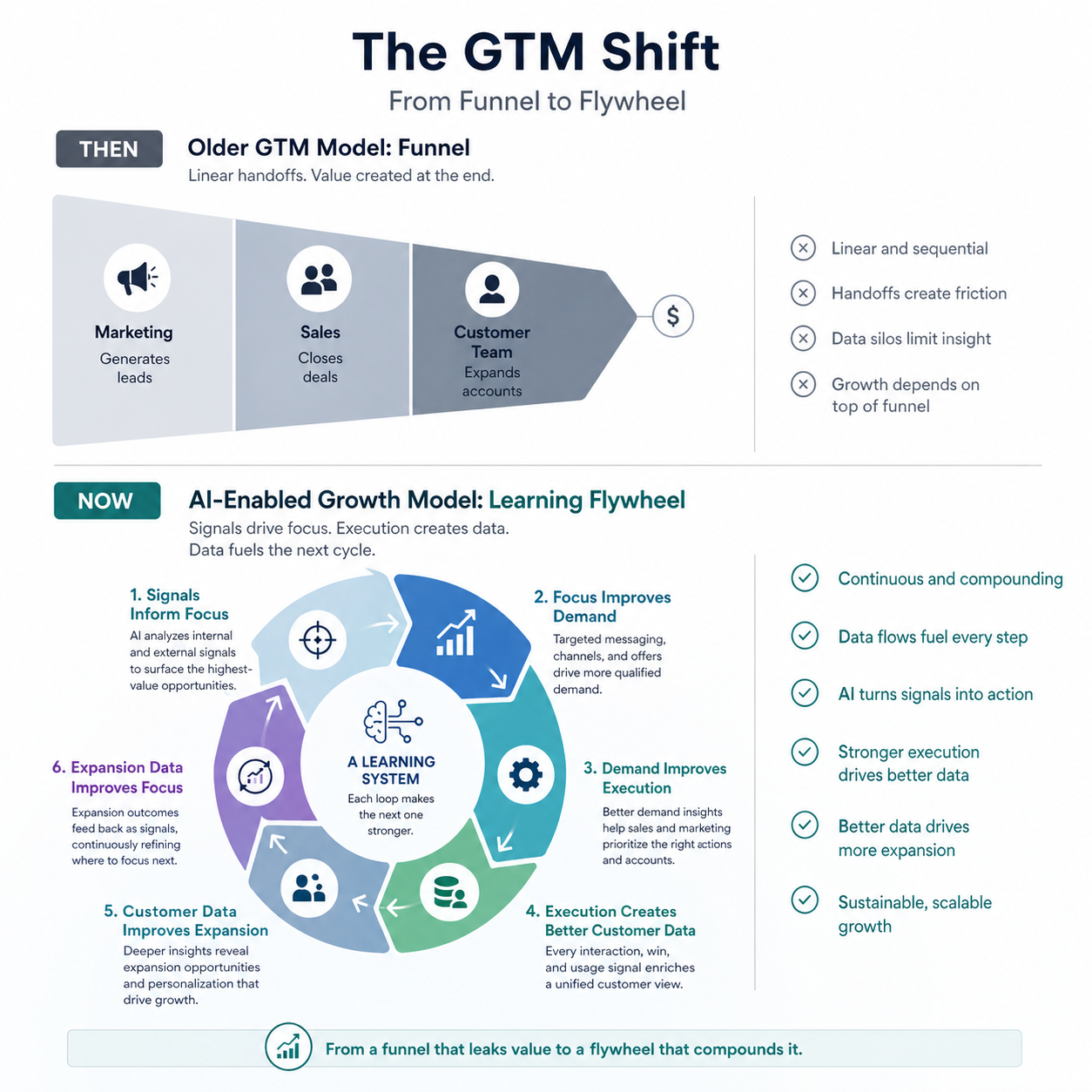
In the AI era, expansion is lifecycle growth informed by real signals, not generic customer communication.
Why This Changes the Identity of Marketing
Taken together, these four pillars redefine what marketing is for.
Marketing is no longer best understood as a department that creates awareness and hands off leads. That definition is too narrow for an AI-enabled revenue environment. The more accurate definition is this:
Marketing is the function that helps the business align audience, message, timing, journey, and value creation across the full revenue system.
That is a much bigger mandate.
It means modern marketing teams must become stronger in:
- data interpretation,
- segmentation,
- lifecycle strategy,
- journey design,
- sales alignment,
- revenue operations thinking,
- customer intelligence,
- performance measurement tied to progression, not just acquisition.
This does not mean marketing owns everything. It does mean marketing has to think beyond its historical boundaries.
The new-age marketing team should ask:
- Are we improving focus?
- Are we generating qualified demand?
- Are we helping demand convert?
- Are we supporting retention and expansion?
- Are we using AI to increase relevance and reduce waste across each stage?
Those are revenue questions, not just marketing questions. That is exactly the point.
The New Standard for Marketing Performance
As AI matures, the standard for evaluating marketing will continue to rise.
It will no longer be enough to celebrate:
- high lead counts,
- low CPL,
- campaign engagement,
- traffic growth,
- vanity metrics detached from revenue quality.
Those numbers still matter, but they are no longer sufficient. The better question is whether marketing is helping the company build revenue momentum.
That means improving:
- the precision of focus,
- the quality of demand,
- the efficiency of execution,
- the consistency of expansion.
This is ultimately what AI makes possible. It creates a more connected, signal-rich environment in which marketing can contribute far beyond the top of the funnel. But that also means marketing becomes more accountable. When the system is more measurable, the function must be more responsible for outcomes.
That is not a threat. It is an opportunity.
The teams that embrace this shift will become far more strategic inside their organizations. They will move from campaign operators to revenue architects. They will help the business not only attract attention, but direct it wisely, convert it effectively, and grow it over time.
Closing Thought
The four pillars of repeatable sales still matter as much as ever. But in the AI era, they are no longer just a sales framework. They are a blueprint for how the entire revenue engine should work.
Focus sharpens where attention goes. Demand creates qualified momentum. Execution turns momentum into revenue. Expansion compounds growth over time.
And marketing now has a role in all four.
Modern marketing teams should not think of themselves as lead generators. They should think of themselves as builders of revenue momentum across focus, demand, execution, and expansion.
That is the real impact of AI on go-to-market strategy. It does not just make marketing faster. It makes marketing accountable to the whole revenue system.